
Paper vs. Digital Business Cards: You're Asking the Wrong Question
You're at a trade show, the energy is high. You meet a promising contact, pull out your phone, and tap your sleek NFC business card to theirs. It's a smooth, modern exchange.
Then you meet the decision-maker for your dream client. You offer your phone for a tap. They smile, reach into their jacket pocket, and hand you a thick, elegantly embossed paper card.
What do you do?
This is the central conflict of modern networking. The debate of "digital vs. paper" isn't a debate at all - it's a daily reality. Declaring paper "dead" is a great way to alienate half of your best prospects. The most successful networkers in 2026 aren't choosing a side; they are building a bridge.
The Modern Networking Landscape: A Quick Comparison

| Feature | Paper Cards | Digital/NFC Cards | The Hybrid Approach |
|---|---|---|---|
| Exchange Reliability | 100% - Always works | 80% - Relies on tech/NFC | 100% - Prepared for anything |
| Your First Impression | Traditional, can be classic | Modern, tech-savvy | Adaptable, professional |
| Data Entry Friction | Very High - Manual typing | None - For your info | Low - For their info |
| Follow-up Speed | Slow - "I'll do it Monday" | Instant - For them | Instant - For you and them |
The Case for Digital: How You Show Up
Let's be clear: having a digital business card (like a Popl, a QR code, or a V-card) is an excellent move.
- • It's efficient: One tap and your information is in their phone.
- • It's impressive: It signals that you and your company are modern and forward-thinking.
- • It's sustainable: No wasted paper.
Using a digital card is the best way to present yourself. It removes all friction for the other person to save your details. But this is only half of the networking equation.
The Enduring Power of Paper: How They Show Up
Here’s a truth many tech evangelists hate to admit: paper is not going away anytime soon. Why?
- 1. The Zero-Friction Guarantee: A paper card requires no battery, no Wi-Fi, and no compatible phone. It works 100% of the time. In a chaotic convention center with spotty service, reliability is king.
- 2. The Ritual of Trust: For many seasoned professionals, the physical act of exchanging cards is a ritual. It’s a moment of tangible connection and respect. Handing over a well-designed card says, "I came prepared for this conversation." Rejecting that ritual can be a subtle-but-costly-insult.
- 3. The C-Suite Reality: The higher you go up the corporate ladder, the more you encounter key decision-makers who prefer the simplicity and classic feel of a paper card. Are you really going to tell the VP of a Fortune 500 company that you "don't do paper"?
Ignoring the reality of paper cards isn't a sign that you're futuristic; it's a sign that you're unprepared.
The Hybrid Strategy: The Bridge Between Worlds
The problem isn't paper. The problem is the friction of getting the information from that paper into your digital system.
The mountain of cards you bring back to the office is a pile of good intentions that quickly becomes a source of dread. Every minute you spend manually typing names, emails, and phone numbers is a minute you're not selling. And as we know, waiting until Monday to follow up means those leads are already ice cold.
This is where the bridge comes in. The perfect workflow looks like this:
- 1. You Share Digitally: You offer your NFC card or QR code for a seamless transfer of your information.
- 2. You Receive Physically: They hand you their paper card. You accept it graciously, making eye contact and acknowledging the connection.
- 3. You Digitize Instantly: As you walk away, you use a web-based tool like CardSync on your phone. You take a quick photo. The AI reads the card with perfect accuracy and has the data ready. You can even add a quick voice note: "Met at the keynote. Follow up about the Q3 logistics proposal."
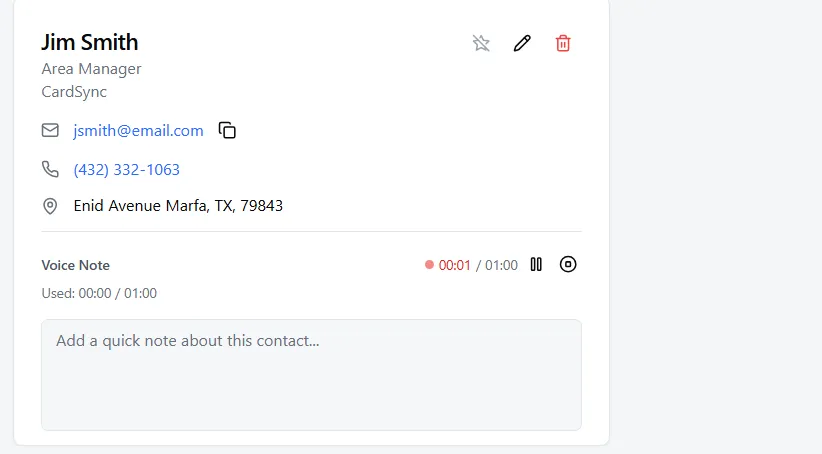
There is no pile of cards. There is no Monday data entry.
You have respected their method of connection while instantly integrating them into your modern, lightning-fast follow-up system. You get the best of both worlds: the tangible respect of the paper exchange and the digital efficiency that actually closes deals.
Stop thinking "either/or." The future of networking belongs to those who are prepared for "both".

